Showing posts with label Eiffel Tower. Show all posts

Monday, February 10, 2014

Game Theory

I've talked about Ticket to Ride, a board game about trains around Europe. But that's just the tip of it. We're big into family game time, especially on cold, rainy winter weekends, and we especially love games that tie in thematically with our lives here.

Memoire de France is a memory-match game with special places around France, including many Paris spots we know and love -- one of which we can see from our window, and exactly half of which we can walk to in five minutes or less:

 
To read about more great French- and European-themed games, check out the post at A Year in Fromage.

Saturday, July 6, 2013

Lady Liberté

July 4 is just another day here, but by complete coincidence, Gigi and a bunch of her classmates have an after-school get together in the park to celebrate their own impending liberation: their last day of school on July 5 before summer vacation and heading off to middle school. It evolves into them choreographing a gymnastics routine, then getting the idea to pass the hat, and then inspiration: Gigi proposes donating the money to organizations that free children from slavery. Amazingly, in just an hour and a half, they earn 50€, which we donate to Free The Slaves. Only after the fact do we realize how perfect this is: Children working with joy to help liberate children who work in misery -- and all on a day that (for some of us, at least) represents freedom.


So, with July 4 just past and July 14 (Bastille Day) approaching, and since the French and American revolutions were heavily linked in many respects, let's take a moment to look at some of the many, many references to Lady Liberty floating around Paris:

In the Jardin de Luxembourg, you might jog by her in this beautiful setting.


Translation of the plaque: "Liberty Lighting the World, Auguste Bartholdi (1834-1904)
On the occasion of the World Expo of 1900, sculptor Auguste Bartholdi offered to the Luxembourg Museum the bronze model he used to create the Statue of Liberty in New York. This statue was placed in the Luxembourg Gardens in 1906." This is, in fact, the original statue upon which all subsequent, larger versions are modeled.
 
At the Musée des Arts et Metiers, the backdrop is drastically different, and the information only slightly different: Here, the artist is more fully identified as Frédéric-Auguste Bartholdi, and credit is also attributed to Gustave Eiffel, the famous engineer known for working with behemoth metal structures. At this museum, which is dedicated to inventions and progress, Lady Liberty stands both outside and inside, with an original 1/16th model. The outside lady is made of bronze, and is created from the original plaster, which is housed inside against a beautiful stained-glass window.


At the Eiffel Tower, engineer Gustave Eiffel's role in the copper statue is, naturally, the highlight. A panel explains: "The framework of the Statue of Liberty, a gift from the people of France to the United States, was one of the outstanding works of the 1880s. Its metal framework was designed like a bridge pylon."
 

If you're wondering why the buildings behind the great Lady with scaffolding look so very French, it's because this is a photo of her being assembled in Paris in 1884, before she was disassembled and shipped to the United States for re-assembly. (One of the few instances where even in English, I would say "she" instead of "it." Thankfully, the word "statue" is feminine in French, because referring to the Statue of Liberty as "he" would simply fry my brain.)
 
But the most impressive and visible of the great Ladies is the one presiding over the middle of the Seine, from the Ile aux Cygnes at the Pont de Grenelle.
 
 
There are two dates inscribed on the tablet Lady Liberty holds in the middle of the Seine: July 4, 1776, the date of the signing of the Declaration of Independence, and Aug 26, 1789, the date of the signing of the Declaration of the Rights of Man and of the Citizen (Déclaration des droits de l'homme et du citoyen), which is to the French revolution pretty much what the Declaration of Independence is to the American one. Both dates are written in Roman numerals (July IV, MDCCLXXVI and Aug XXVI, MDCCLXXXIX). In New York, only the July 4 date is inscribed.
 
 
Originally, she was facing east into the city for the World Expo of 1889, then turned to face the mouth of the Seine (northwest) for the 1937 World Expo. But at the time of a renovation of the island and bridge in 1968, she was turned outward, so that she now looks west (and more specifically southwest) towards New York, while the Statue of Liberty in New York's harbor looks east toward Europe. Theoretically, their gazes should meet somewhere over the middle of the Atlantic, or, if you think about it, perhaps their gazes simply continue east, east, east or west, west, west, till they circle the globe entirely. Wouldn't it be nice if all people caught between and beyond their gazes were indeed living in liberty?
 
  
                                 New York                                                 Paris 


Sunday, April 21, 2013

How Gauche!

Paris is famously divided in two by the Seine, the so-called Left (gauche) and Right (droit) Banks. But is the gauche really gauche? Well, in some places, of course. But mostly the left bank is the charming home of the Latin Quarter, Sorbonne, Jardin de Louxembourg, Eiffel Tower, Invalides/Napoleon's tomb, Musée d'Orsay, and many of the toniest arrondissements in the city (specifically the 6th and 7th). The right bank has the Louvre, Opéra, Grand Palais, Bastille, Marais, Pompidou, and Jardin de Tuileries and some of the trendiest neighborhoods. Many people support one side or the other quite strongly, but I feel I can be pretty neutral on the Right Bank/Left Bank divide, since we don't live on either: Ile Saint Louis and Ile de la Cité are in the middle of the Seine and, therefore, neither here nor there.


Much as I have gone through my life with a mental block confusing oven/stove and dishwasher/washing machine, I have to imagine myself facing west from the tip of Ile de la Cité when I need to remember which is Left Bank, which is Right.

That's Left Bank.........................................................................................................and Right Bank.


If you're wondering, our meaning of gauche as "awkward" or "tacky" is indeed a reference to left-handedness. Yet the word "right" (in both French and English) means correctness or legal rights. The word "sinister" also comes from the Latin word for left. Poor lefties.


But here's the real problem, at least in my anglophone mind, with all this left-and-right: The way to say "go straight" is "tout droit", which literally means "all right". So if you are told to go à droite, you go right, but if you are told to go tout droit, you go straight. I would think if you went all right -- right after right after right, you'd end up right back where you started, but, as Steve Martin once said, "Boy, those French, they have a different word for everything!"

I've been thinking about this a lot, because Pippa is working on left and right in her class and, as you can see, has a way to go to get these concepts down. She has such difficulties -- in both French and English -- that a part of me wonders if it's some genetic legacy from her paternal grandmother, who was naturally left-handed but forced to become a righty and who, consequently, had right-left dyslexia all her life.


One day Pippa comes home from school and tells me her teacher made a boy change hands while working. Though I try not to be the crazy helicopter American parent, I do feel I have to say something, given the results this practice had on my mother-in-law. I am aware that Pippa is not the most accurate source of information, however, so I gently ask before accusing. And a good thing: her teacher is confused, thinks a moment, then says, "Yes! I did make a little boy change hands to use his scissors. Because he's a lefty, and he was using his left-handed scissors in his right hand. Which is actually a little dangerous." When she sees the look of relief on my face, she laughs and said, "Don't worry. Even in France, we don't do that anymore."

Of course the French wouldn't be that sinister. How gauche of me.


Wednesday, April 17, 2013

School with a View

And I thought my workspace was impressive....

We go to an Open House at the girls' school, because Pippa is performing with her class in a circus-themed medley of songs.


While there, we tour the classrooms, just to see the girls's desks and art-work on the walls. We've done this before, of course, last year and this past fall. But they are in new classrooms, because there was a recent renovation to add in an elevator (for accessibility purposes) to the school. Gigi is now on the top floor, the 5ème etage (6th floor by US counting). We can never forget this as she often complains about how she walks a minimum 40 flights of stairs per school day (up 5 floors, down 5 for 1st recess, up 5, down 5 for lunch & second recess, up 5, down 5 for 3rd recess, up 5, down 5 at the end of the day).


The school must be well-placed, because the next-door neighbor is French telecom billionaire Xavier Niel. He bought the old hospital museum complex for around 50 million. Euros. In dollars, it would have been a steal. He's selling off some portions of the 4,000 square meter complex (that's near 40,000 sq. ft) into smaller million, two million euro apartments along the quai, facing the Seine. His own portion, seen in part on the right in the photo below, will have a nice private garden and end up about 1,000 sq m. It's not our apartment on Ile Saint Louis, of course, but still -- not too shabby.


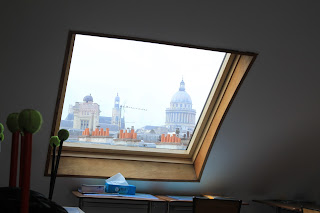
And neither is Gigi's new classroom. A converted old attic space, it has the most stunning views of any place I've seen in Paris, slightly edging out an apartment we decided not to take in favor of our current lovely abode.


This is the actual view sitting at her desk. From the various windows -- not to mention the balcony just outside -- you can get a clear view over the Paris rooftops of the Pantheon, the Montparnasse Tower, and a tower of the Sorbonne. That's just on one side. On the other side, we have a crystal clear view of Notre Dame, with Sacré Couer in the distance (hard to see in the photo, but easy in real life), alongside the dome of Sainte Chapelle. I feel like the school should charge admission to tourists for this view. I am, frankly, very jealous.


And if you look carefully from the balcony, there's a view of the Eiffel Tower. A distant view.


Along with the awe-inspiring view over monuments and rooftops, the school also brings in a flashy science demonstration for the Open House.


But before you go thinking their school has it all, please take note of these two computers we find in the classrooms -- the only ones we see. Anthony points out that they still have floppy disc drives. The Bay Area this ain't.


Saturday, April 13, 2013

Your Planning Guide

As a Follow-up to Your Packing List, I give you Your Planning Guide. My couster also writes:

"I am interested in doing some great art pilgrimage, but I am not sure how to gauge the suggestion to take a full day to go to Versailles. Worth it? Better to spend the day stuffing my face in a café somewhere? Just trying to get my bearings so I can start to consider if I actually have specific things I'd like to do in mind or not. It's hard to tell sometimes: Somewhat reputable NYC tourist travel sites suggest things like 'go to Chinatown'...which makes some sense if you're from, oh, Oshkosh or BoFo (which, in my world, would be in Nebraska), but less so if you're from SF. I also dug up a few other things. If you get a moment, feel free to read them, laugh, scream in righteous indignation, or praise them. It'll give me a better sense of what's in store."   

1) Among the various recommended five-day itineraries she sends me (examples one, two, and three here), one has her visiting the Louvre, the Musee d'Orsay, and l'Orangerie in one day. I would barely recommend this in one week, unless you really, really love art museums. And do not have children traveling with you. The Louvre alone could take a whole day, and you still would only see a fraction. If you've never done any of them, I recommend the d'Orsay, simply because the Impressionist collection is such a jaw-dropper and so enjoyable (not the kind where you pretend to enjoy staring at your 127th Virgin and Baby painting because you feel like you're getting educated, but the kind where it is actually pleasurable). If you happen to be here on the first Sunday of any month, most museums are free.


2) Do you want to go to the Eiffel Tower? Be prepared for crowds, and lines, unless you can go at a low-traffic time, which is mid-week, not on a school holiday, first thing in the morning, and ideally in the dead of winter. The crowds will be lighter then for sure. Get a reservation ahead of time, and know that "walking up" only means walking up to the 2nd floor; everybody gets an elevator to the top from there. It is fine to walk up, even with children. My seventy-something year old parents just did it, too.
 

3) Do you want to go to Versailles? You don't need reservations, but expect crowds. It's certainly worth doing, especially on a day nice enough to enjoy the gardens, Marie Antoinette's hamlet (her pretend peasant village), and maybe even boat rides on the lake. But is it a must-see? No, and it does take a whole day. The problem is that almost everything in Paris falls in this category -- fabulous but not a must. Because of that, I say, don't try to pack everything in your five days. Just do the things that appeal to you most and leave time for just wandering around. And eating.

4) An alternative to Versailles, in my opinion, if you can't spare a whole day: the more convenient and less crowded Palais Garnier, also called Opéra, which has English-language tours on Wednesdays and Saturdays (reservations needed). Or just go for an unguided visit nearly any day.

4) My advice on planning, in short. Some medieval Paris, at least one great art museum, a cemetery, some cafe time, churches, a tower (Eiffel and/or Notre Dame and/or top of Arc de Triomphe), boat ride or walk along the Seine, shopping, ride a metro, Sacré Coeur from the outside, Sainte Chapelle and/or Conciergerie, les Invalides, maybe underground sewer tour or catacombs, and something truly opulent like Versailles or Opéra. But not all of it at once.

Monday, December 3, 2012

Paris, a Book Report

Even though the girls are reading "chapter books" now, there's still room for breaking out a picture books for a quick bedtime story. They've heard it a million times, and it's really too "babyish" for them, but the girls still love to hear Madeline. What's the draw? Well, it's the drawings. The pictures mean so much more to them now. The words on each page take about two seconds, but we analyze each illustration. Have we been there? Have we seen that angle? How does it look different today?

We can play the same game with Eloise in Paris, and Téa Stilton: Mystère à Paris (Thea Stilton and the Mystery in Paris, but we have the French version), and any other illustrated books set here.

Drawing vs. Photograph, Fact vs. Fiction, Then vs. Now: I can come up with the following guide without even having to break out my camera, because all of these are photos already in my existing files:

Notre Dame (Madeline):


Jardin de Luxembourg (Madeline):


Les Invalides (Madeline):


Sacré Coeur (Madeline):


Pont Alexandre III (Eloise in Paris):


Arc de Triomphe (Eloise in Paris):


On the subject, my friend Sue sent me this T-shirt which is both à propos and très chic. It's Madeline at the Arc de Triomphe.


Tour Montparnasse (never heard anybody call it the Tour Maine-Montparnasse, whether that's its official name or not, from Téa Stilton: Mystère à Paris):


Le Grand Escalier (the Great Staircase) at l'Opéra (Téa Stilton: Mystère à Paris):


And, of course, each book has its own views of the Eiffel Tower, such as this one with fireworks and balcony view (Eloise in Paris):


Eiffel Tower as seen from across the Seine, at night (Téa Stilton: Mystère à Paris)


Eiffel Tower (Madeline):


And finally, one that little to do with Paris, but a lot to do with book illustrations and their real-life counterparts: While we are living here, Pippa makes that huge jump in reading level where she can start to read "real" books. Her first effort (age 6, last Christmas) is to read a book of her namesake: Pippi's Extraordinary Ordinary Day. In honor of finishing her first book, I re-create the feast from it and, yes, am dorky enough to insist on staging the photo to match the Michael Chesworth illustration, too.