Showing posts with label US/Europe conversions. Show all posts

Saturday, July 5, 2014

Le Butter Chicken Bagel

Nothing says "authentic New York bagel" quite like an Indian restaurant called "Le Butter Chicken" serving bagels in Paris.


If you haven't read my story about the Brooklynization of Paris (alternate title: Bagels, and Donuts, and Hot Dogs, Oh My!) at A Year in Fromage, you can read it here.

Friday, June 6, 2014

My D-Day Hero

Why am I posting such an ugly picture of myself over at A Year in Fromage? It's a story that's well worth a little humble pie.
 
I've met a fair number of very (very) famous people in my time, and rarely have I been so star-struck, and never have I been so moved. It's the 70th anniversary of the Normandy Invasion:
 
 
For the full story, click here.

Wednesday, April 23, 2014

Puppet Regime

Is Obama a puppet? According to the French Guignols de l'Info -- News Puppets -- he sure is. It's funny stuff, and the French have been skewering us, themselves, and just about everybody else in the world for twenty years in this way. See more at A Year in Fromage.

Friday, April 11, 2014

About Time

Long ago, you've heard me complain about the wonky clock on my cell phone (it turns out I was the one who was wonky, and just didn't know how to set it). But now that I know about a little historical tidbit called French Revolution Time, my wonky clock seems like child's play. Go ahead, just try to wrap your mind around all this clock conversion math at A Year in Fromage.


Saturday, March 15, 2014

Got Me Pegged

My friends and family have me pegged. Besides lots of electronic messages with birthday wishes, I received three physical cards in the mail. One of them:


For the other two cards, both my sister and one of my best friends picked out the same one:

 
Inside the card, the punch line reads, "Oh yeah...like if you had magic shoes, you'd go to Kansas."
 

Wednesday, November 13, 2013

Chocolate Chip Champion

My friend Mei and I like to champion here in Paris (and abroad) that ugliest but perhaps most delicious of desserts: the American cookie.

The first year of gymnastics regionals, Gigi's team got 13th out of 13. The second year, when she came home with a 9th place, Anthony congratulated her enthusiastically...until she told him there had only been 9 teams. Well, much like this, I fancy myself quite a delicious cookie maker, but then I only have a couple really good non-French friends here, and the only other American's cookies I've tried are Mei's. And, objectively speaking, hers are better than mine. So there may only be two contestants, but I'm the Silver Medal Champion Cookie Maker of My Paris!

And my cookies do whoop the pants off any chocolate chip cookies I've tried that were made by any French person. I have to admit that the cookies I make here also whoop the pants off the cookies I make in San Francisco, and I've figured out the secret: I use all-American ingredients except the butter. French butter has less water in it, and is generally richer and more unctuous, and the cookies are all the better for it.


If you're wondering why there are so many cookies on my counters, and why some of them are upside down, there's a logical explanation for both. Gigi likes me to make her cookies for her class for her birthday. She's in a class of 29 kids, plus a teacher, and I feel like everybody should have at least a couple cookies. So you do the math: that makes a whole lot of cookies, which I must mix by hand -- no KitchenAid stand mixer. It's better than a gym workout for the upper arms, except that I eat more calories worth of raw dough than I burn.

And why upside down? Along with no stand mixer, I also don't have a cooling rack, and I've discovered that putting them bumpy side down allows them to cool without getting soggy, as the steam can find nooks and crannies through which to escape.


Sure, I could buy chocolate chip cookies. There is a cute little shop on our island called "Anne's" which sells single, regular-sized (say, 3" diameter) cookies for 2.7€ -- or about $3.50 -- each. Meanwhile, I can go to Thanksgiving (the store in the nearby Marais neighborhood, not the holiday) and find critically important ingredients for not too much money, including real light brown sugar for under 4€ and baking soda for just a couple more. Still infinitely cheaper than buying at Anne's, where we would need to take out a second mortgage in order to buy a couple dozen cookies.


The expensive ingredients are the real liquid vanilla and the chocolate chips, and I have cabinets full of both, thanks to a steady stream of visitors. However, I refuse to make chocolate chip cookies for any of my visitors from the States. I only make them for other ex-pats who need a taste of home and for French-people who, I must tell you, are completely won over by this ugly-but-delicious American dessert.

Thursday, October 17, 2013

First Rule of Book Club

Gigi and I have put together a book club with the girls from the Native English section in her grade. Of the thirteen girls, six come to the first organizational meeting. These are all theoretically native English speakers (though in truth, most are bilingual children who've grown up in France, and probably only Gigi would claim English as her first and strongest language), so it never occurs to me to put much of an explanation about what a book club is. Just another example of how very American I am.

Nearly everybody shows up with some books they like, that they could recommend and swap with each other, but I don't think any of them understood that a book club is a place where you discuss a book that you have all pre-read. What amuses/amazes me even more is that the parents themselves didn't understand the concept of a book club. Despite coming in blind, the first one was a raging success, and there are at least two new girls joining in for the first actual book discussion in about a month's time. It may have helped that one of the girls brought homemade cupcakes. The girls have picked from among their own favorites for their first few books:


My own San Francisco book club ladies and American friends and family (nearly all of whom have been in book clubs) will share in my amazement over the concept of not knowing what a book club is. There are many things that I am vaguely embarrassed to export to the rest of the world -- McDonald's, violent films, and Miley Cyrus spring to mind -- but I must say that if Gigi and I can introduce a bunch of her new friends and their families to the idea of book club, I'd be mighty proud.

You know a Paris Mom's book club (fewer cupcakes, more wine) can't be far behind....


Saturday, October 12, 2013

His and Hers

For the last year, I have wondered why my daughters started making mistakes in what I consider one of the most basic aspects of English: "his" vs. "hers". They are constantly saying things like, "This is Paul and her wife," or "When is Mommy going to finish his phone call?" While their French is bilingual, let's face it: We haven't been here that long, and it's not like they've actually forgotten English.

So why? Why are they asking about Daddy and "her" work? I finally figured it out. Because whereas gender in English belongs to the subject in question -- Paul and his wife -- in French, the gender belongs to the object in question -- Paul et sa femme. So, for example, an apple is feminine (la pomme) which means that whether the person who has the apple is Paul or Marie, either way it would be sa pomme (his or her apple).

Paul et sa pomme (Paul and his apple)
Marie et sa pomme (Marie and her apple)
Paul et son cartable (Paul and his backpack)
Marie et son cartable (Marie and her backpack)

When the object of the sentence actually has a gender, but one that doesn't match the gender it's assigned in French, it's even more confusing. A great example: a lady with her baby daughter. In French this would be

la dame et son bébé (The lady and her baby).

While neither the subject (the lady) nor the object (the actual baby) of that phrase is masculine, the possessive pronoun "son" is. This could easily happen with a female teacher (le prof), a mother (if referred to as un parent), a female doctor (le médecin), and many others.

Now, to my grammatical horror, my girls sometimes even mix up the actual words "he" and "she". Gender is, apparently, a very fluid concept -- even more fluid than when we lived in San Francisco.


Wednesday, October 2, 2013

Confusion Says

Here they are: the two most confusing conversations to have in a French-English multi-lingual environment. Like our own household:

1) "How was your entrée at dinner last night?"

Well, if you hear the word "entrée" in French, and this is what you get, then great.


But if you hear it in English, then you expect a full main course. Which it is not. It is an entrée, as in the entry into your meal, or what we call an appetizer. Why do we call the main course the "entrée" in English? It makes no sense at all.

2) The girls tell me about their day at gymnastics, "My front flip was great!" Well, do they mean flip in English, which is a tuck or flip with no hands touching the ground? Or do they mean flip in French, in which case it's a handspring? It's hard to know because they regularly sprinkle their English conversations about gymnastics with French terms.


Those are French flips above, and American back-handsprings.


Friday, September 27, 2013

Sticker Shock/ Sticker Joy

I go to the local dry-cleaner/tailor and am quoted 78€ (about $100) to replace the zipper on a kid's denim jacket. It's as if I suddenly don't speak French, because I have to ask, re-ask, and repeat the number half a dozen times. Finally, needing to confirm that I'm not just misunderstanding something, I ask, "Soixante-dix-huit? The digits 7 then 8?" The jacket itself probably didn't cost me more than $3, because I'm pretty sure I bought it at Goodwill in the first place.


So what else causes Sticker Shock in Paris, even after a couple years here?:

Children's shoes: boots, for example -- the kind a girl might wear with leggings and a dress, leather-style (though probably not real leather) and not super-well made -- start around 80€, over $110, in the stores, and many hover at 100€ or about $135. In the U.S., for $80, I could get the girls a much better-made pair. But this isn't the sort of thing that can easily be bought over the internet and brought in somebody's luggage. They need to try it on and like it.

Granted, I live in an expensive area, but still, does 6€, or about $8 for a cup of tea seem reasonable? We are talking, after all, about a cup of hot water, with a tea bag that costs less than 10¢ at full retail price (so, what, 5¢ wholesale?). I don't like coffee, so I'm always stuck when we stop at the café ordering an $8 cup of tea, hot milk, or hot chocolate.

Housing: This is Paris, after all. At the moment, places in good neighborhoods rent for around 36€ per square meter, which works out to about $5/sq. ft per month. This is less shocking when moving to Paris from San Francisco, frankly, where places rent for about $3.70 (measured against averages at one point during 2013). But even we are a little stunned by the prices to buy something. About $800,000 for a 400 sq. ft. studio? But I want three bedrooms. Uh, maybe in the next life.

And let's not even get into fish pills (seen at over $100 for a small bottle), dental floss (about $7 at the admittedly overpriced pharmacy below us), or chocolate chips (about $5 for 100g, which is about 1/2 cup, or only half as much as I need to bake a batch of cookies). Seen below is the approximately $205 worth of Costco-sized chocolate chip bags that people have brought to us from the US. Actual Costco total for both: $23. And now you know why we've asked you to bring these in your luggage.


On the other hand:

There's private school. When I sign Gigi up for her new school next year, they tell me that in addition to the $1800 private school annual tuition, there is an extra $1800 fee for the special program they offer for native English speakers (extra hours, at native Anglophone level, paid entirely by parents of the children in the program). Apparently, my face registers no shock, horror, or concern over the additional annual fee, so they assume I don't understand and keep repeating the amount to me: total $3600 -- annually. The same $3600 would be approximately the monthly charge for private school in San Francisco, per child. This is Sticker Shock in reverse. It's Sticker Joy.

The girls' gymnastics program also gives me Sticker Joy. For 730€, or just under $1000, both girls will do three days per week, plus competitions, for the whole school year. Pippa will be doing 7-9 hours per week, and Gigi will be at 6, and there are 35 weeks, with a few days off thrown in, so roughly 475 gym hours total. For just $1000. What will $2 per hour buy for child care and children's activities (especially good quality ones) in the U.S.? I don't know: I think you'd have to go back to 1964 to find out.


Other things that cost shockingly, joyfully little:

Babysitters -- roughly $10/hour, vs. $15-20 in San Francisco, which is, officially, the most expensive city in the U.S. for babysitting.

Kids' clothing -- lovely French fashion, and while prices can, of course, be astronomical for high-fashion, the basic play-clothes kind of stores are no more expensive than the U.S. And with sales, prices get quite low indeed (3-7€ for regular play/school clothes, for example, by the end of the sales).


Medical care -- Pippa hurts her foot badly enough at one point that we decide to get it X-rayed for stress fractures (none, it turns out). Before any insurance reimbursements, the full cost we pay for it is 75€, around $100. Quite affordable. And then we get nearly all of it back from the insurance company, anyway. And a month of prescription levothyroxine which costs $10 in the U.S. after insurance costs only $3 here at full price.

Coffee -- if only I liked it. Quick coffee (espresso) nearly anywhere is 1.5 - 2€. A slow, lingering espresso at a lovely French café? About 2 - 2.5€.

Bread -- roughly 1.5€ ($2) for an incredibly great loaf of bread, and less than that for a fabulous pain au chocolat or croissant. Bread products here are subsidized by the government in the way that milk is in the U.S., to keep prices reasonable (and regulated). Better and cheaper than in America. Sigh.


Sunday, September 22, 2013

All Aboard the Penmanship

If you're American, then like me, you probably remember learning how to write your cursive letters in 3rd grade. That's what they do in California public schools still today, to a lesser degree. But in some US states, they no longer teach cursive at all; according to a recent article that went out on the AP wire, 45 states are considering standards that don't require cursive at all.

Well, in France, it starts in kindergarten (Grande Section) -- and remember that children are younger here in each grade, since the cutoff is Dec 31 (with no redshirting, or voluntary holding back of the younger children). That means that children go into kindergarten as young as 4 years and 9 months, and during that school year, they are expected learn some cursive, certainly at least enough to write their own names. By the end of 1st grade (called CP), they are writing exclusively in cursive for their assignments.


What makes it even more challenging for our girls is that they are not always writing their cursive homework with ballpoint pens. Often, they use calligraphy-style pens with ink cartridges and nibs. This is not by choice; it's a school requirement, beginning in the middle of 2nd grade (called CE1).


The French are very exacting about how cursive is learned and written; thus, there is a very distinctive French penmanship. I can tell French handwriting at a single glance. My own is most definitely American. There are some letters that were taught to me differently than how my daughters learn them. There are other letters where I just do whatever comes fastest and easiest, whether it's "official" cursive or not.

For the letters, the girls' writing looks French, but it's universally legible. For the numbers, however, they have to worry about the fact that their 1s look like American 7s. It's a problem when writing out phone numbers or numbers. Then again, it's all a matter of perspective; they think some of my own letters are bizarre. Notice the differences between the French (top chart) and American (bottom chart) uppercase A, G, H, I, J, N, Q, S, X, and Z, along with the lowercase P and number 1.
 

For people who say kids younger than 3rd grade are too young for cursive, here is an assignment written at age 7 and 1/2 (and yes, the francophones among you will notice many errors, but see how pretty it looks!):
 
My mother, who used to teach at the university level (in the school of education, forming future teachers), said that she was stunned at the block-printing her students would use for essays. Not only did it look childish, it also was slow and laborious. For notetaking, it's a complete disaster.
 
I've always thought that our girls learning cursive is a great thing; I had my own completely unfounded opinion that, like learning to crawl before walking, writing cursive must do something beneficial to the brain. Well, it turns out to be true. There's an interesting article published in Psychology Today about it, and the crux of it says:

In the case of learning cursive writing, the brain develops functional specialization that integrates both sensation, movement control, and thinking. Brain imaging studies reveal that multiple areas of brain become co-activated during learning of cursive writing of pseudo-letters, as opposed to typing or just visual practice.

There is spill-over benefit for thinking skills used in reading and writing. To write legible cursive, fine motor control is needed over the fingers. Students have to pay attention and think about what and how they are doing it. They have to practice. Brain imaging studies show that cursive activates areas of the brain that do not participate in keyboarding.

So, difficult as it is, in our family, we don't curse the cursive. We are 100% on board the penmanship.

Monday, September 9, 2013

Faster than a Bullet

It's a plane! It's a train! Actually, it is a train. And it's not really faster than a bullet. Or even a bullet train. But it is, in fact, very super. It's the train system throughout France, and Europe, and we've made good use of it, especially thanks to our "Carte Enfant +" which is a card we buy in Pippa's name for 70€. It lasts one year, can be re-purchased annually till she's 12, and means that up to four people who travel with her by train get a discount -- minimum 25% and often 50% -- on rides in France. There are other discount tickets available (frequent business traveler, retiree, large family, etc). The prices can be so low, they're shocking.


For example, our two hour train ride to Normandy costs me and the girls about 30€. They're not all this cheap, of course, but it's still a great way to travel -- and nearly always cheaper and faster than going by car. Just this summer alone, the girls and I trained to Normandy, Paris, Avignon, Cinque Terre Italy, Florence, night train back from Munich to Paris, Auxerre Burgundy, Joigny Burgundy, Paris, Bretagne, Paris, Aigle Switzerland, and one final trip back to Paris. Anthony flew or trained to meet us and travel with us for various parts of it, but had to work, so we often came through Paris for the weekends he couldn't join us. It was a confusing and utterly exhausting summer, to say the least.


All that train time means snacks at the train station, snacks on the train, card games, story time, snuggle time, sleep time, video games, and even the occasional (mild) motion sickness.


While most of our trips are on the high-speed TGV (in general running up to 320kmph or 200mph), our trip to Avignon is on the new Ouigo train. It's equally high-speed, is owned by the national train lines, but is being positioned as the People's Express/Southwest Airlines of French trains in terms of pricing. The downside of the Ouigo is that the "local" station is not actually in Paris but rather a half hour train ride outside of the city at Disneyland, and you have to wait on a long line to check in. It only runs to a few cities, but they are key ones down South. The upside is the price of the tickets: the trains are clean, fast, and comfortable, children cost 5€ each at all times, and my ticket costs 30€ -- for a 3-hour high speed train ride all the way across the country. My ticket would only have cost 10€ if I hadn't been picky about the time and day.


As we train around Europe, our girls recognize many of the names from one of our favorite board games. We call it "the Train Game," but its real name in English is "Ticket to Ride," and the French name is "Les Aventuriers du Rail" (Adventurers by Rail).


After all those train rides, we feel like we really need a vacation from our vacation. But exhausting and exhaustive as our summer travels are, we remain thrilled by how much better it is to travel by train than by plane. Even in 2nd class, we're traveling in style.

Saturday, August 10, 2013

In With a Bang

In with a squirt: Pippa welcomes our Bay Area friends to Paris, and France, and Europe by squirting them from our balcony with a water gun upon their arrival one hot afternoon. James and Trina dub it the "Best Welcome Ever," but, alas, Pippa is to hold the crown for less than 24 hours.

In with a bang: The morning after their arrival, we train down to Avignon together, where we will be staying as the guests at the rather wonderful villa of James and Trina's business associates/new friends. We arrive not only to a beautiful villa with a swimming pool, but also to three succulent chickens roasting on the grill, served with some great local cheeses and wine and sparkling conversation. After dinner, the villa's owners drive away, leaving us as kings of the castle. It's heaven and, upon reflection, slightly outshines a water gun and a fold-out sofa bed.


In with a thwack: From the villa, it's a quick drive to the medieval Château des Baux, where we all try shooting crossbows. The arrows go in with a satisfying thwack, and nearly all of us at least hit the target.

 
Out with a bang: At the 1100 year-old château, James gets to help wind up the second largest trebuchet in the world (the first being by Loch Ness in Scotland) and then be the one to pull the "trigger" rope, sending a volleyball to its untimely and rather explosive end. He volunteers extremely enthusiastically -- and explains medieval armature to Trina, myself, and the children in such detail -- that I am once again reminded of the difference between boys and girls. As with Anthony in la Dordogne last year, it's also fun to see James'  12-year old self emerge at the prospect of a day spent as a knight.


In with a clang: After the château, we continue our day of testosterone at the 2000 year-old Roman arena in Arles, where the clanging and grunting and sweating (and even occasional bleeding) of gladiators is alive and well. It's fun to think that this was already a thousand year old ruin when the thousand year old château was just being built.


While there are no deaths, we do notice at the meet-and-greet-and-try-on-equipment afterwards that the main gladiator (the guy holding the pitchfork in the photo) has a mangled, swollen, and bloody hand. All of them have battle scars on their backs, legs, and arms. They take this seriously.


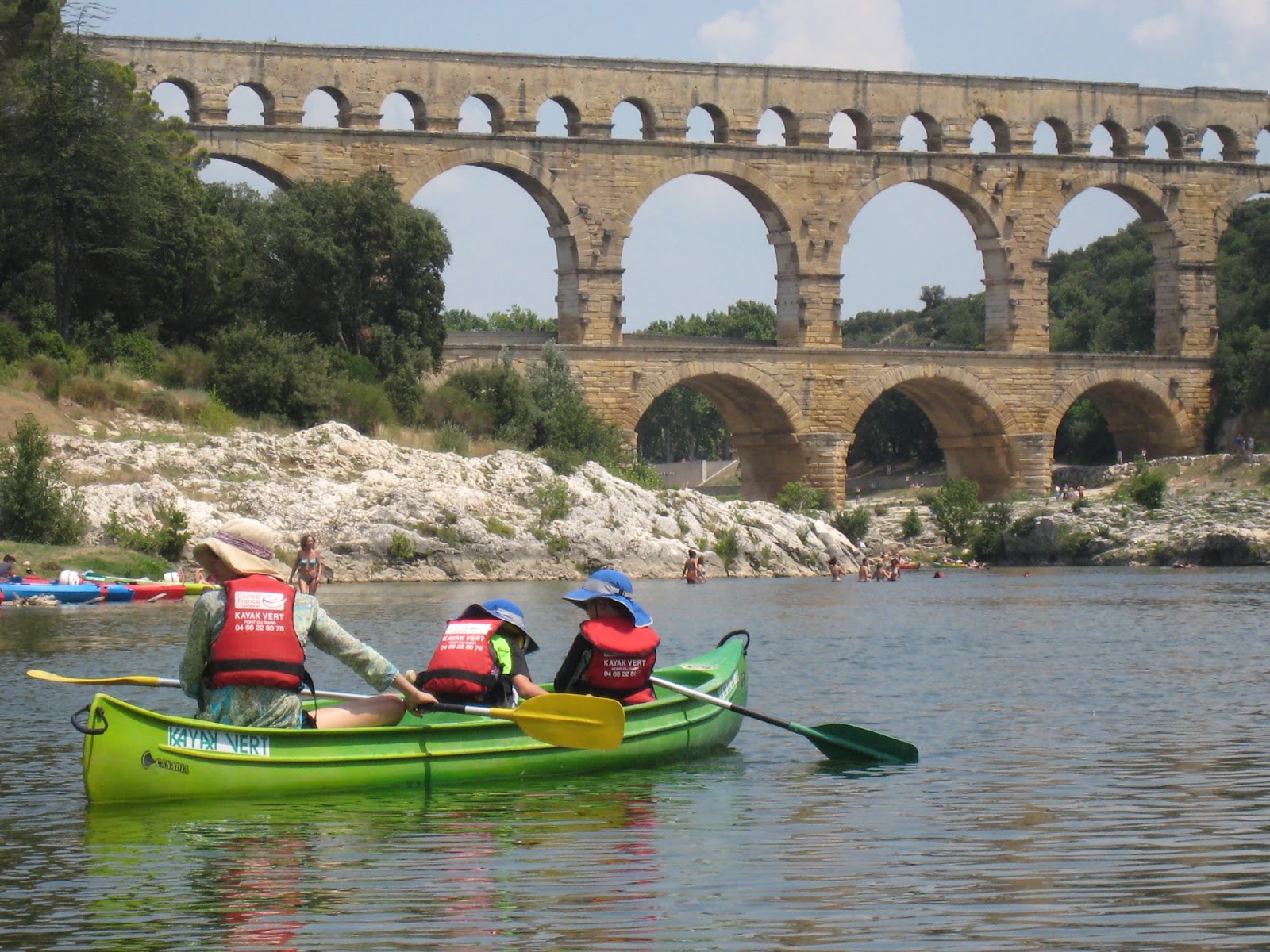
In with a splash: 2000 years ago, while gladiators were battling it out in the arena, the Romans also built this amazing aqueduct, the Pont du Gard. The engineering is impressive for any era: It is the highest of all existing Roman aqueducts. It drops 2.5cm, or just under one inch, over the span of the bridge, and just 17m (56ft) over the entire span from neighboring village Uzès to its ultimate goal in Nîmes about 50km (31 miles) away.


The bridge was built to bring water to the people, but two millennia later, it's bringing people to the water. Besides boatloads of kayakers -- both literally and figuratively -- there are also swimmers and cliff-jumpers. It's hard to beat this as a backdrop for a place to cool off in a heat wave. I wonder what the Romans would think of it all?