Monday, May 21, 2012

He/ It Is Risen

Yet another holiday here in France --  this past Thursday was Ascencion, a traditionally Catholic (but now federal) holiday for which many people take the Friday pont (bridge). For the long weekend, there are numerous event tents set up in front of the grand cathedral of Notre Dame which are, naturally, dedicated to the rising of....the bread.
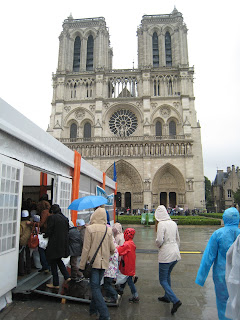

Yes, Ascension weekend coincides with "La Fête du Pain," a specialty fair here on the grounds of Notre Dame. Five days of celebrating bread, educating people about how bread is made, and convincing them of the seemingly non-controversial assertion that, according to their earnest slogan, "boulanger, c'est un métier" ("bread baker, it's a profession").


Since the girls' school is so close to Notre Dame, the teachers take the opportunity for a field trip (mysteriously, all grades go except G's, which turns out fine, since she's home sick anyway). The kids get to roll out their own bread loaves and also watch a film about the process of making bread, from growing the grain all the way to analyzing the crust color and shape of the finished product.


Lest you are under some "Bringing Up Bébé" delusion that everything about raising young children in France is simply perfection itself, you should know that the teachers take this opportunity to provide the children with flags promoting "le sucre" ("sugar") and huge sticks of cotton candy (colorfully called "barbe à papa" which means "daddy's beard"). Mind you, it is 10:00 in the morning. So don't believe this tosh about how French children never snack and only eat healthy foods. They eat crap, too.


Here is P, at home, triumphant with her braided loaf. The Jews out there will see it as a Challah. My kids will be so mixed up, celebrating the weekend of the risen dead Christ savior (known better as Jesus) with a savory risen bread twist (goes better with cheeses).


Thursday, May 10, 2012

May Work, May Not

Just after the vacation for the last two weeks of April, the girls also had Mon Apr 30 off, since it seemed silly for all of us to come back for one day, only to go back on vacation for Tues May 1, Labor Day, and national holiday. Especially since they don't have school Wed anyway, thereby ruling out May 2. So instead they went back to school from spring vacation on Thurs May 3, and before you could say "Bob's your uncle," it was the weekend.

After two strenous days on, and then two off, they went back to school on Mon May 7, only to have two more days off: Tues May 8, WWII Victory Day (which Anthony also had off), and the usual Wed.

Next week, the girls do have school on Mon and Tues, and a special added Wed school day, trading for the "pont" (bridge) day they will be given off on Fri May 18. Thurs May 17 is Ascension, which while of obvious Catholic origins is still a national holiday. Fri May 18 is then taken as the "pont" to extend the weekend.

When we return from that long weekend, we have one entirely normal week of school (Mon, Tues, Thurs and Fri) and then another day off on Mon May 28. 

So, if I seem a little behind on everything, i.e. the Morocco blog, perhaps you'll understand. And if I say I will call you on Tuesday, and it doesn't happen till Friday, it's because I usually don't have any idea what day of the week it is. And if you think it's just because we're new here -- no, the entire country is unproductive this month. And if it sounds like I'm complaining about having too many days off, please just remember that days off of school do not mean days off for me; on the contrary, I work harder (but get less accomplished) when I'm taking care of the kids on their days of "vacation."

May work? May not...


Sunday, May 6, 2012

Storming the Bastille

We interrupt our regular scheduled program (which is to post our Morocco trip, now that I am back in Paris with a computer) for this special message:

Sarkozy: C'est Fini!


And I do not have to look at the news, which tells me Socialist candidate Francois Hollande won the French presidential election with 51.9% of the vote, in order to know this. All I have to do is listen at my window. A population which appears from two stories above to be mostly "young adult" marched by our window in a steady stream for about a solid hour, and is still trickling by, heading from the Latin Quarter -- the Sorbonne and other student populations -- on the Left Bank to the Bastille on the Right Bank chanting both "Sarkozy: C'est Fini!" ("Sarkozy, It's Over!") and the more general "On a gagné!" ("We won!"). The chanting, singing, and general merriment are accompanied by cars honking, bullhorns, and noisemakers. It calms down after a couple hours, but I presume they will all be returning home to the Left Bank -- much, much drunker -- around 3am.


For obvious historical reasons, the Bastille is the place to go whenever you either want to overthrow the current regime, or celebrate that you've done just that. There are so many French flags waving on our bridge and beneath our window, I fully expect the music from the finale of Les Misérables to swell in the background.


The girls seize the opportunity to delay getting in bed, during which time we are informed that nearly all the children in G's third grade class, along with several lunch monitors, do not like Sarkozy, and therefore this Hollande win is clearly a good thing. One of the children tried to explain the awfulness of Sarkozy to G by telling her "Sarkozy won't even let your parents vote here!" It's true, of course. I really can't argue with that statement, and yet I have to break it to her that Hollande won't allow us to vote here either, since we are not just non-citizens but non-citizens who have to reapply for the carte de séjour recently stolen from me.

There is a dark side of any politician, and G tells us soberly that one thing the children fear from Hollande is that he advocates adding back not just Wednesdays but also (gasp!) Saturday mornings to the French school week.  Sacré bleu! Or, in honor of today, Sacré bleu, blanc, et rouge!


Friday, April 27, 2012

Teeny-Weeny Monokini

[Heading off for vacation! Follow our adventures in Morocco, in which Family by the Seine tries not to get lost in the (funky cold) medina, in the desert on a horse with no name, at midnight at the oasis, or while rocking the kasbah. You can also sign up there to follow by e-mail. Postings from France will restart in mid-May].


We have friends in town from San Francisco, and since they have been to Paris many times and done all the tourist spots, and since it is a rainy gray day, and because the 11-year old girl has very fond memories of this activity from a trip here when she was just 6, we head out to Aquaboulevard. It's a huge indoor-outdoor waterpark for ages 3 and up, and it costs a small fortune (naturally), but it is really something to see.

photos from: http://www.sejour-paris.net/2011/08/24/aquaboulevard-de-paris/ and http://www.snelac.com/les-sites-de-loisirs/aquaboulevard-de-paris

As soon as we get in, Anthony looks around and notes that he is the only man or boy in site in board-shorts. I tease him that if we live in France long enough, he may have to go buy one of the tiny, tight Speedo-style suits the men wear here. They come in two varieties: banana-hammock and shorts so small I have taken to calling them teeny-weeny monokinis. He looks at me and says, pointedly and very sincerely, "You will NEVER see me in one of those." Flash-forward about five minutes, and I look up to see him walking toward me in his new Euro-metrosexual bathing suit.


There are numerous signs that long shorts are not allowed, and that everybody must be in a bathing suit, but the girl at the desk has told us she thinks Anthony's American-style suit will be acceptable. The lifeguards and staff in charge of the pool itself disagree, however, and they bust him within minutes. So, he leaves us in the pool area and heads over to the vending machines, where he agonizes for a few moments deciding between sizes and coming back with something that leaves little to the imagination. We are all curious why the insistence on tight suits for men (and not just here, but at all public pools in France); they claim it's for hygienic purposes, but that doesn't explain it adequately, as we can't figure out why board shorts would be unhygienic. Perhaps it's just a fashion aversion to bagginess? Macho exhibitionist desires?

Aquaboulevard has a rope swing, seven big water slides that are currently open (with four more closed along with the outdoor portion of the park for winter). For one of the slides -- the favorite of our girls and visiting friend, ages 6, 8 and 11 -- we crowd into a huge green raft which takes us through a mighty chilly outdoor portion before depositing us back indoors. It is not just fast for the kids; even Anthony and I are whooping it up.

photos from: http://www.offi.fr/enfants/aquaboulevard-1415.html and http://www.epitech.eu/olympiades-ionis-2009-art746.html

There's a vertiginous slide no children under twelve are allowed on, and I am happy we don't ignore the warning in our usual way, as it so fast and steep, neither Anthony nor I can even keep our eyes open. There's a wave pool, a wakeboarding pool (too old for our crew), hottubs, and much more, all with generously heated water. Amazingly, other than a few signs stating that children under twelve are the responsibility of the mandatory accompanying adult, there are no signs warning you away from activities if you are pregnant, old, immuno-compromized, left-handed, in a foul mood, etc. There are no signs telling you that you could be hurt, maimed, injured, or in any way harmed by these activities. We sign no waivers, and there are not even lifeguards regulating the top of the slides -- just red and green lights, which each person miraculously obeys (this is not, actually, typically French of them). There are signs showing you not to go head-first, or telling how many people are allowed in each kind of inner-tube, and they assume you are both smart enough and law-abiding enough to follow them. To an American, this is an oasis of common sense, self-awareness, self-responsibility, and non-litigiousness. The only thing they seem to overregulate is men's attire. Let's see that one more time:


All of this aquatic fun can be had for 28€ per adult and 15€ per child (and a few more euro for the teeny-weeny monokini) at the front desk. It appears after-the-fact that there may be a family pass (2 adults and 2 kids) for just 52€, but it's not offered to us and is unclear whether this needs to be bought online in advance or, the next time, we need to know enough to ask for it explicitly. Needless to say, this time we do not know, and they charge us 86€ ($113) for the family of four.

We are there for about two-three hours before we are purple-lipped and starving. The day gets a huge thumbs up from all involved. On our way out, P states emphatically that Aquaboulvard is way better than Disneyland. Then she reflects a moment and qualifies, "well, way better than Disneyland Paris."


Tuesday, April 24, 2012

Why I Like 69

This is my 100th posting from Paris, and I would like to honor it by admitting that it is very, very hard for me to count to 100. In French, that is.

For those of you that don't speak French, you should know that the number all make sense until
#69, and after that it all goes to hell. To say the #70 involves mental addition: "soixante-dix" literally means "sixty-ten." Fair enough, but that also means that #71 is "sixty-eleven" up to #76, which is "sixty-sixteen."

In English we start our "regular" teen numbers at #13, with eleven and twelve given special names. In Spanish, the switch happens at #16 (transitioning from "quince" to "dieciséis"). In French, it happens at #17, going from "seize" to "dix-sept" (literally "ten-seven").

This means that #77 is "sixty-ten-seven," continuing up to #79 ("sixty-ten-nine"), at which point we switch to multiplication.

To say #80 in French, you say "four-twenty" (as opposed to #24 which is "twenty-four"). Then we go back to addition, on top of the multiplication: #85, for example, is "four-twenty five." Then at ninety, you say "four-twenty ten" ... all the way up until my most dreaded numbers: #97, 98, and 99.

80=(4 x 20)
87=(4 x 20) + 7
90=(4 x 20) + 10
96=(4 x 20) + 16
97=(4 x 20) + 10 + 7
98=(4 x 20) + 10 + 8
99=(4 x 20) + 10 + 9

As you may have noticed, I am more of a word person. I mean, I made it through math classes just fine, but playing with numbers has never been particularly fun to me, whereas I regularly scramble letters from street signs around in my head just to see what I can create. So there I am, speaking French rapidly, fluently, and with my "adorably sexy" not-quite-native accent, and suddenly I need to say the number #92. All time seems to stand still as I start doing the math in my head....

Phone numbers in France are eight digits long and broken into pairs when spoken out loud. So the number 12345678 is usually written 12.34.56.78 and is read out "Twelve, thirty-four, fifty-six, seventy-eight." Our home phone and both of our cell phones contains lots of numbers over 70 (my cell phone is exclusively numbers over 70, in fact). I've found that more than one person has written my number down incorrectly, putting 60.12 when I do not say "soixante-douze" or "sixty-twelve" -- which is actually the number #72 -- fast enough.

Contrary to my own personal belief, it turns out the French did not come up with this counting system just to mess with my head, and my French.

This base-20 (or vigesimal) counting has Celtic origins, and appeared in French counting as early as the eleventh century after William the Conquerer hit English shores and brought back with the Normans the concept of "skor" (as in four score and seven years ago....). Presumably, the base-twenty idea grew out of the fact that you can count to twenty using toes and fingers.

In researching this, I came across other counting systems that make me grateful to be living in France. Author Claudia Zaslavsky describes the Yoruba system in her book Africa Counts -- another vigesimal system but one that uses subtraction. Numbers in each group of ten from 1-4 are added to the tens place below, and numbers from 5-9 are subtracted from the tens place above. For example,

35 = (2 x 20) - 5
47 = (3 x 20) - 10 - 3
51 = (3 x 20) - 10 + 1

This is only true up to 200, after which, she writes, "the system becomes irregular." Holy hell. Then it gets irregular?!

Denmark also has vestiges of the vigesimal system, with things really kicking in after #50. So while #40 is simply #40, #50 is "four and half-third." This means: halfway toward the third group of twenty (which would be 60, and halfway there would be 50).

66 = 6 and third
73 = 3 and half fourth

There is, apparently, also a counting system based on 60 which is called sexagesimal. France does not use this system for primary counting, which is lucky for my brain but unlucky for my writing, as I am itching to make some sort of tacky "sexagesimal" pun. I think my cousin Kevin will be the first to come up with a zinger.

But don't think that means you are free from knowing what it's about, because we're all still using this system to some extent. The sexagesimal system started with the Sumerians (approx. 300BC) and went through the Babylonians all the way straight through to us today, which is why we tell time in chunks of 60 (sixty seconds to the minute, sixty minutes to the hour) and angles in terms of 360°. The reason is because 60 can be divided so neatly into so many components: 1, 2, 3, 4, 5, 6, 10,
12, 15, 20, 30, and 60 and, by extension, 360 can be divided into six groups of 60.

Researching this leads me to the book The Universal History of Numbers by Georges Ifrah, which I am intrigued enough to buy for our family to see if we all enjoy geeking out on it. How does this tie in? The author is French. You see? It all comes full circle. 100 postings in half a year, and more to come: You can count on it. But probably not in Yoruba, Danish, or even French.


Saturday, April 21, 2012

The Long Arm of the PAW

You can run, but you cannot hide. They will hunt you down, mercilessly, pitilessly, tirelessly. "They," of course, are the Annual Giving office at Princeton University.

The very first letter we received at our new apartment here in Paris was from Princeton: a request for a donation to some department or other. Today, we receive three pieces of mail from Princeton on the same day: a request for money from the rowing association (Anthony rowed his freshman year), a thank you card for having donated to Annual Giving (which we did online, to save paper, but then they mailed us a card anyway...), and the PAW (a.k.a the Princeton Alumni Weekly, a magazine which does not actually come out weekly, which you can see as ironically humorous or moronically misnamed).


When I lived in the Philippines, I spent about six months teaching scuba diving (I call it my ski bum phase, but I did it underwater) on a tiny island called Boracay. At that time, Boracay did not have regular electricity, and my housing did not have plumbing of any sort. I lived in a little cabin where I had to cross a sandy path beneath the palm trees in order to get to the outhouse I shared with a Filipino family, except that I couldn't go to the bathroom during wind storms for fear of a coconut falling on my head. That would be an embarrassing obituary: "Killed by a coconut on the way to pee."

This was before the days of wide-spread internet and e-mail, and certainly cell phones, and my parents would not have been able to find where I was on a map if you paid them. So you can imagine my surprise when one day I was called off the beach to the dive shop because a phone call had come through from the States. I raced to the phone, imagining some health scare from one of my parents. Instead I heard a chipper voice saying, "Hello, Ms. Regelman? My name is Ashley, and I'm a senior here at Princeton University. We want to thank you for contributing regularly in the past and would like to know if you would donate to Annual Giving this year as well..." 

As I am finishing the previous paragraph, I hear a ping telling me an e-mail has arrived in my inbox. It is, naturally, an e-mail from Princeton class of '89 telling me to check out my class website and also pay my class dues. Moments after (and I am not exaggerating this for effect), I see on my facebook home page an invitation from the Princeton Alumni Association of France to a gathering in two weeks at an Irish pub in Paris. If I write this post much longer, I expect a knock on the door from a perky undergrad in a tiger-striped sweatshirt, armed with sleeping bag, tooth-brush, and point-of-sale credit card reader.

So, you may wonder where in the world I am, but the omniscient Orange-and-Black already knows where to find me. And, if you are a Tiger, they know where to find you, too. So don't bother to hide; they're coming for you...


Tuesday, April 17, 2012

F*** That

Anthony picks G up from her hip-hop class tonight, and parents are invited in for the last ten minutes of class to watch. He finds himself a bit dumbstruck, watching the 8-12 year olds dance their hip hop routine to a song with the following lyrics:

Loca People (listen to it here):
When I came to Spain, and I saw people partying
I thought to myself, what the fuck
All day, all night
All day, all night
Viva la fiesta, viva la noche
Viva los DJ's
I couldn't believe what I was living
So I called my friend Johnny
And I said to him
Johnny, la gente esta muy loca
What the fuck
Johnny, la gente esta muy loca
What the fuck
When I came to Spain, and I saw people partying
I thought to myself, what the fuck
All day, all night
All day, all night
Viva la fiesta, viva la noche
Viva los DJ's, what the fuck
Viva la fiesta, viva la noche
Viva los DJ's, what the fuck
Viva la, viva la
I couldn't believe what I was living
So I called my friend Johnny
And I said to him
Johnny, la gente esta muy loca
What the fuck
What the fuck

G is the only non-French kid in class, and certainly Anthony is the only adult anglophone in the room. The F-bomb is raining down on the children, as they do their pop-and-lock robots. None of the other parents even flinch.

Though many of them probably know of the "F" word, swearing just does not have the same impact in a foreign language. Frankly, it's even hard to swear properly in a foreign language when you want to. I remember meeting a Chinese man who spoke truly incredible English. You could almost believe he was American until he said that something was "unbe-fuckin'-lievable." This was the linguistic kiss of death, as any native speaker would know to say "un-fuckin'-believable."

So I realize I will probably never curse like a native French person, but it certainly would help to recognize the words, since for years when talking to little children about bumping into something ("cogne") I mistakenly used the pejorative word "con" -- which I have since seen translated as: complete idiot, arse-wipe, dick-head, shit-for-brains, stupid bastard, fuckwit, and utter twat, among others.

So here's a course curse course from my French friend Aurore:
  • mon cul = my ass. Same meaning as the softer mon oeil = my eye. Meaning, "bullshit." Has been said by her teenage son to her. Not horribly shocking, but don't say it to a teacher.
  • trou de cul = asshole. C'est vraiment un trou de cul. What an asshole.
  • con, and by extension connard and connasse (masculine and feminine versions) = ass, cunt, prick, basically all pejorative words for genitalia rolled into one.
    • Quelle connard! What an asshole.
    • Gros con = big asshole.
    • Petit con = small asshole. Could be said to kids in the South of France, but not in the North, where they are more puritanical. According to Aurore. Who is from the South.
  • merde = Shit! A child could say the softer version of this -- "mince!" in public. But the word "merde" itself is considered a very bad word.
    • You can say, "Je te dis les cinq lettres," meaning "I say the five letters to you," as in the awful five-letter word. As an American, looking at these words in translation, it's hard to see "merde" as worse than "con," but the French do.
    • Can also be called "le mot de Cambronne," Cambronne being Napoleon's general whose answer to the Brit's demand for surrender at Waterloo was this carefully-chosen nugget.
  • pétas (in the South), pétasse (in the North) = whore
  • putain or pute = whore, and also every possible other thing in the world. Eggs are undercooked? Putain. This putain car is not parked properly. The pute dress is out of stock in my putain size. While its meaning is vague, the sentiment is clear. Children should not say this in school.
  • ta gueule = Shut the Fuck Up! Not to be confused with "taisez-vous" = shut up, but more in a "be quiet" way. Whereas "taisez-vous" is said by teachers to children, "ta gueule" is used by drugged up gang members about to get into a knife fight.
  • dégage or casse-toi = Beat it! Get lost!
  • va te faire.... Aurore, a lovely French woman with a posh English accent, cheerfully spews out a string of these "Va te faire..." curses:
    • Va te faire foutre! = Go fuck yourself!
    • Va te faire mettre! = Go get yourself fucked!
    • Va te faire enculer! = Go get yoursef fucked up the ass!
    • Va te faire sodomiser! = Go get yourself sodomized!
    • Va te faire chez les grecs! = Go get done to you whatever those Greek guys are doing, probably with sheep, in the horrible stereotypes we all enjoy perpetuating!
  • When I ask about "fou-toi," which I was taught in American jr. high and high school was "fuck you," I am met with a a blank stare. "No, that's not correct French. It's 'va te faire foutre.'"
And so, having exhausted my knowledge of French curse words and probably horrified my mother and caused my prudish grandmother to roll over in her grave, I leave you with the request that you click here to see why even though this may be a bitch of a shitty posting, I think you'd be a total asswipe not to fucking learn how to curse when you're living in a goddamn foreign country.